【place】に【N】があります/います = exist
Vocabulary
| part of speech | Japanese | Kanji | Engllish | How to use |
|---|---|---|---|---|
| verb | ある/あります 1 | exist (other than people and animals) | こうえんに きが あります へやに ベッドが あります | |
| verb | いる/います 2 | exist (people and animals) | あそこに いぬがいます きょうしつに せんせいが います | |
| noun | おとこのひと | 男の人 | man | |
| noun | おんなのひと | 女の人 | woman | |
| noun | おとこのこ | 男の子 | boy | |
| noun | おんなのこ | 女の子 | girl | |
| noun | いぬ | 犬 | dog | |
| noun | ねこ | 猫 | cat | |
| noun | き | 木 | wood | |
| noun | ベッド | bed | ||
| noun | ソファ | sofa | ||
| noun | まど | 窓 | window | |
| noun | カーテン | curtain | ||
| noun | つくえ | 机 | desk | |
| noun | テーブル | table | ||
| noun | いす | 椅子 | chair | |
| noun | たな | 棚 | shelf | |
| noun | エアコン | air conditioning | ||
| noun | ほんだな | bookshelf | ||
| noun | れいぞうこ | 冷蔵庫 | refrigerator | |
| noun | はこ | 箱 | box | |
| noun | くつばこ | 靴箱 | shoebox | |
| noun | こうえん | 公園 | park | |
| particle | 【N】や【N】(など) | 【N】 and 【N】 (etc.) | きょうしつに つくえや いす(など)が あります。 |
Grammar
【place】に【N】があります/います
To indicate the point of the existing location, use “【place】に“. (To indicate the place to take action, “【place】で“)
“【N】があります” indicates that inanimate things exist.
“【N】がいます” indicates that animate such as people and animals exist.
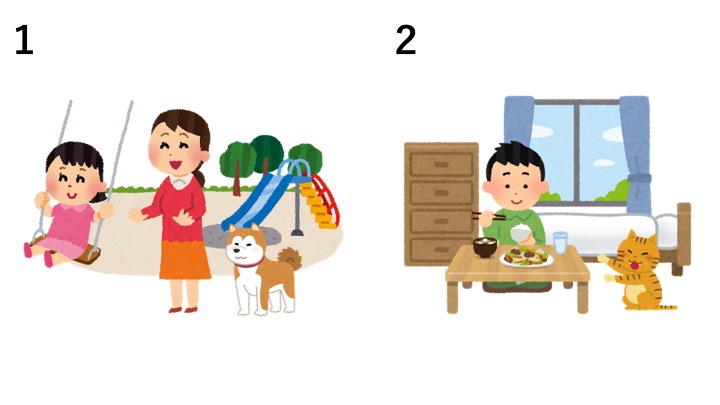
ex.
1.公園に女の人と女の子がいます。
There are a woman and a girl in the park.
公園に犬がいます。
There is a dog in the park.
公園に木があります。
There are trees in the park.
2.部屋に男の人がいます。
There is a man in the room.
部屋に猫がいます。
There is a cat in the room.
部屋にベッドやテーブル(など)があります。
There are a bed and a table (etc) in the room.
*”【N1】や【N2】(など)” picks up some from among various things. When “【N1】や【N2】(など)” is used, it is implied that “there are many other things”. “など” can be omitted.
PracticeⅠ
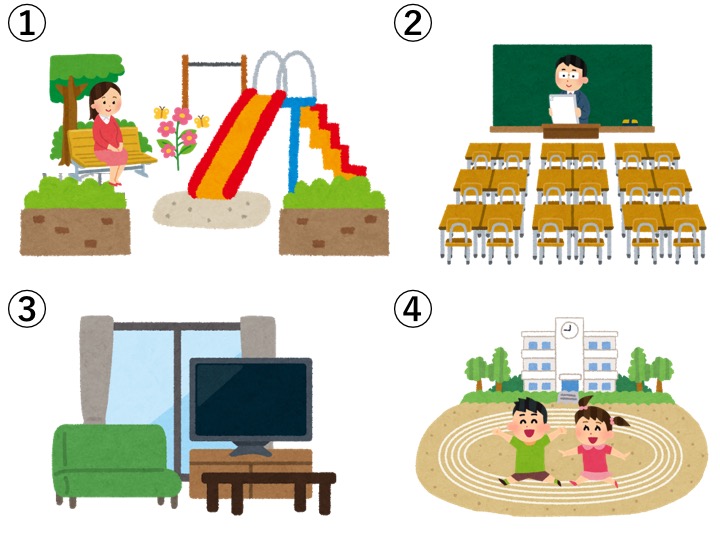

れい)女の人
→Q:公園に女の人がいますか。
A:はい、います。
① 花
② 学生
③ 本棚
④ 男の子と女の子
A.
① Q:公園に花がありますか。
A:はい、あります。
② Q:教室に学生がいますか。
A:いいえ、いません
③ Q:部屋に本棚がありますか。
A:いいえ、ありません。
④ Q:学校に男の子と女の子がいますか。
A:はい、います。
PracticeⅡ
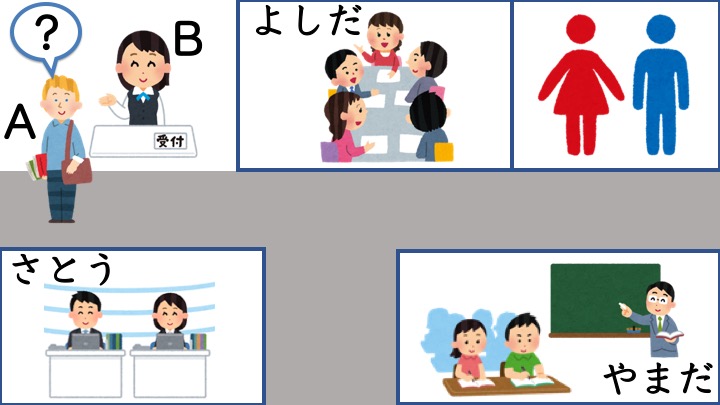
れい)吉田さん
→Q:吉田さんはどこにいますか。
A:会議室にいます。
*If you have the focus of a sentence on a person or thing, such as when you are looking for a person or thing, don’t say “どこに【N】がありますか/いますか”, put 【N】 at the beginning of the sentence, “【N】はどこにありますか/いますか ” is more natural.
*If you want to ask if people or things are exist, use “【N】がありますか/いますか”.
① 佐藤さん
② 山田先生
③ トイレ
A.
① Q:佐藤さんはどこにいますか。
A:事務所にいます。
② Q:山田先生はどこにいますか。
A:教室にいます。
③ Q:トイレはどこにありますか。
A:あそこにあります。
PracticeⅢ
① 部屋にエアコンがありますか。
② 部屋にカーテンがありますか。
③ 【Your name】さんは今、どこにいますか。
④ 【Your name】さんのお母さんは今、どこにいますか。
A.
① はい、あります。/いいえ、ありません。
② はい、あります。/いいえ、ありません。
③ (うち/学校/会社 etc.)にいます。
④ (うち/学校/会社 etc.)にいます。